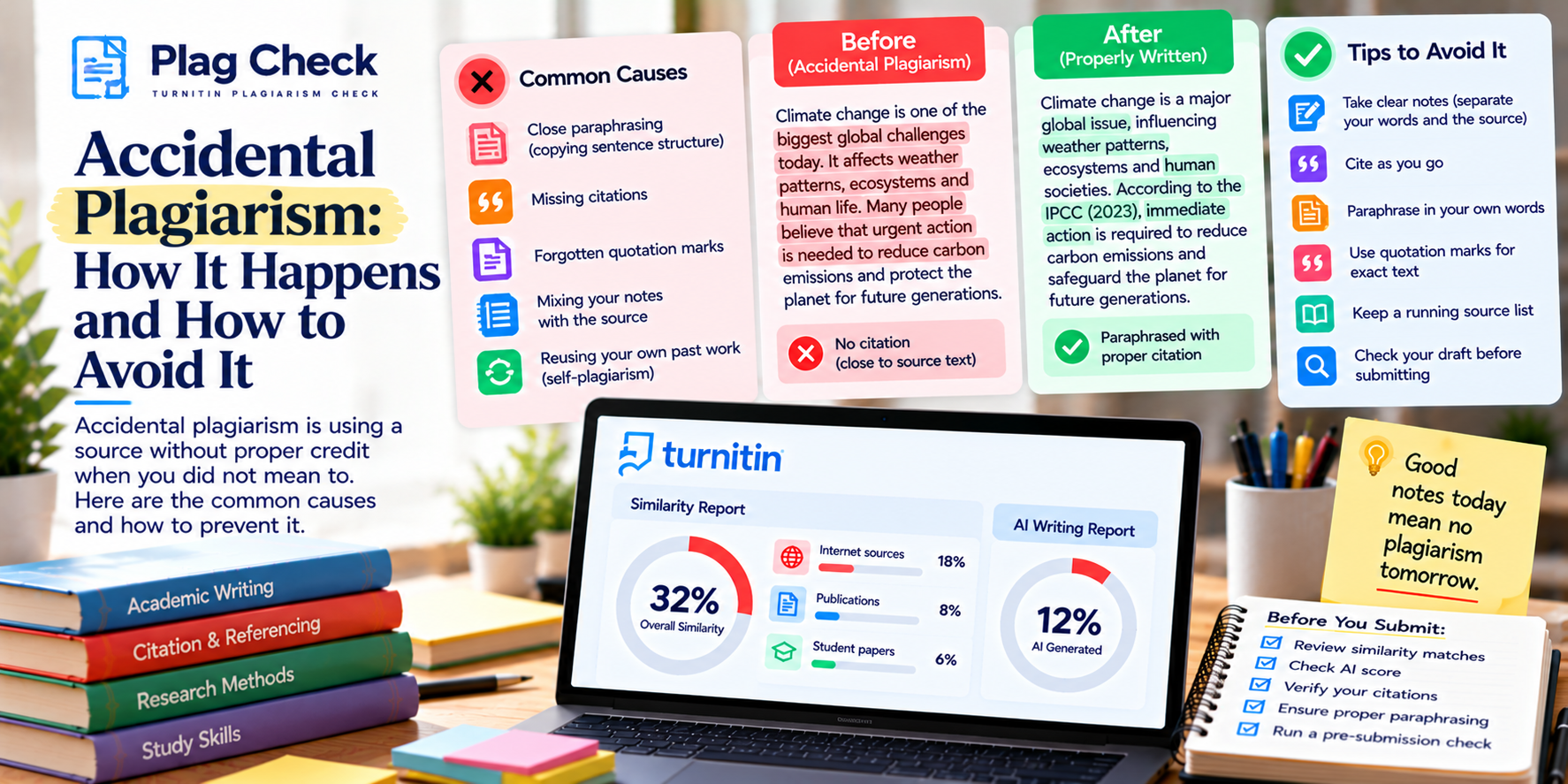
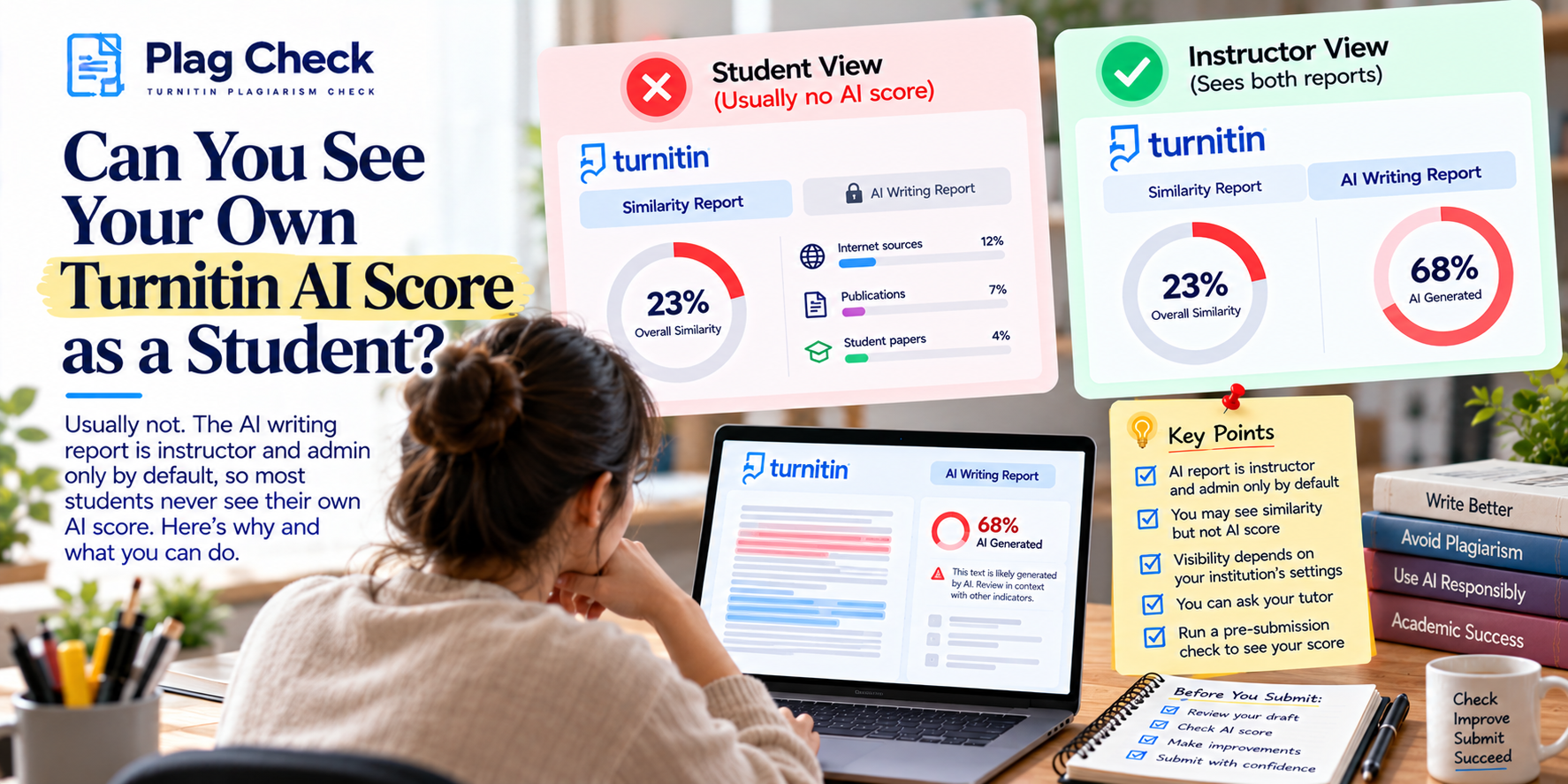
Turnitin compares your work against three pools: billions of current and archived web pages, a large repository of past student papers, and licensed journals, periodicals and books. It does not search the whole private internet or anything it has never been given, so your score only reflects text it can actually see.
Understanding what sits behind the score changes how you read it. A match is not a judgement, it is a note that your words line up with something in one of those pools. We go deeper into reading the report itself in Turnitin similarity report explained, but once you know what the three pools are, a surprising similarity score usually stops being a mystery.
What are the three pools Turnitin checks?
1. The web, current and archived
Turnitin crawls and stores a vast amount of the public web, including pages that have since changed or disappeared. This is why you can match a web page you never visited, and why copying from a site and then deleting your browser history does nothing. If the text was ever public, there is a good chance Turnitin has a copy. It does not, however, see content locked behind logins or paywalls it has not licensed, so not every source on earth is in there.
2. The student paper repository
When institutions submit work to Turnitin with storage switched on, those papers go into a repository that future submissions are checked against. This is the pool most students underestimate. It is why your work can match a classmate’s, a paper from another university, or an earlier version of your own work, which is the trap we explain in checking my paper and saving it to the Turnitin database. When a match is to another institution’s paper, your tutor usually sees that a match exists and its size, but the actual text is restricted, so they request access if they need to read it.
3. Licensed journals, periodicals and books
Turnitin also licenses a large body of published academic content, including journal articles, periodicals and books that are not freely available on the open web. This is what lets it catch copying from paywalled research that a simple web search would never surface. For anyone writing at dissertation or research level, this pool matters a great deal, because so much of your reading comes from exactly these sources.
What does this mean in practice?
Three everyday situations make a lot more sense once you know the pools:
- Matching a classmate you never spoke to: you both drew on the same stored source, or one of your papers is already in the repository.
- Matching yourself: an earlier draft or a past assignment of yours is stored, so your new work matches it, sometimes at close to 100%.
- A match to a source you cannot open: it is likely a licensed journal or another institution’s restricted paper, which is why the link does not simply load.
It also explains a question we are asked constantly: why quotes and references push the number up. They are real matches to real sources, which is why we wrote a full guide on whether Turnitin checks references and quotes.
What does Turnitin not check against?
It is just as useful to know the gaps. Turnitin does not compare your work against the entire private internet, against documents nobody has ever submitted or licensed to it, or against text it cannot read, such as the contents of an image. It also does not judge whether a match is plagiarism. It reports the overlap. A human reads the context and decides. So a match to a source is a starting point for a marker, not a conclusion, and a missing source simply means Turnitin never had a copy, not that copying is safe.
What is the self-match trap?
Because the repository is one of the three pools, where you check a draft matters enormously. If a pre-submission check stores your draft in Turnitin’s repository, that stored draft can come back as a near-identical match when you submit the final version, and it can look alarming on the report. This is the same risk behind self-plagiarism and how Turnitin detects it. A check that does not add your work to the repository avoids this completely, which is the safe way to review a draft before you hand it in.
What do we see in the reports we run?
The single most common cause of a confusing score we see is a student matching their own earlier work. Someone checks a draft somewhere that stored it, then panics when the final submission shows 90-plus percent against an unnamed source that is, in fact, themselves. Knowing the three pools, and keeping your own drafts out of the repository, removes most of those nasty surprises before they happen. The second most common is a long, properly formatted reference list quietly adding ten or fifteen percent, which is not a problem at all once you see where it comes from.
How big is the database, and does it keep growing?
The three pools are large and they grow constantly. Turnitin holds billions of web pages, a very large and expanding archive of student papers, and a licensed collection of publisher content. Every time institutions submit work with storage switched on, the student-paper pool gets bigger. That has a real consequence: a passage that did not match last year can match this year, simply because more work has been added in the meantime. The database is not a fixed snapshot, it is a moving target.
Whether your own paper joins that pool depends on the assignment’s storage setting, which your tutor controls. Some assignments store submissions to the standard repository, some to an institution-only repository, and some do not store them at all. You usually cannot see which applies, which is one more reason to keep your own drafts out of any repository when you self-check.
Frequently Ask Questions
Does Turnitin check the whole internet?
No. It checks a very large archive of current and past web pages, but not content behind logins or paywalls it has not licensed, and not the entire private internet.
Does Turnitin compare against other students’ work?
Yes. Papers that institutions submit with storage go into a repository, so your work can match other students, including from other universities.
Can Turnitin match my own previous work?
Yes. If an earlier draft or past assignment of yours is stored, your new submission can match it, sometimes at close to 100%.
Does Turnitin check journals and books?
Yes. It licenses a large collection of journals, periodicals and books, including paywalled research not on the open web.
Why can’t I open a source my report matched?
It is usually a licensed publication or a restricted student paper from another institution. Your tutor can request access to the full text if needed.