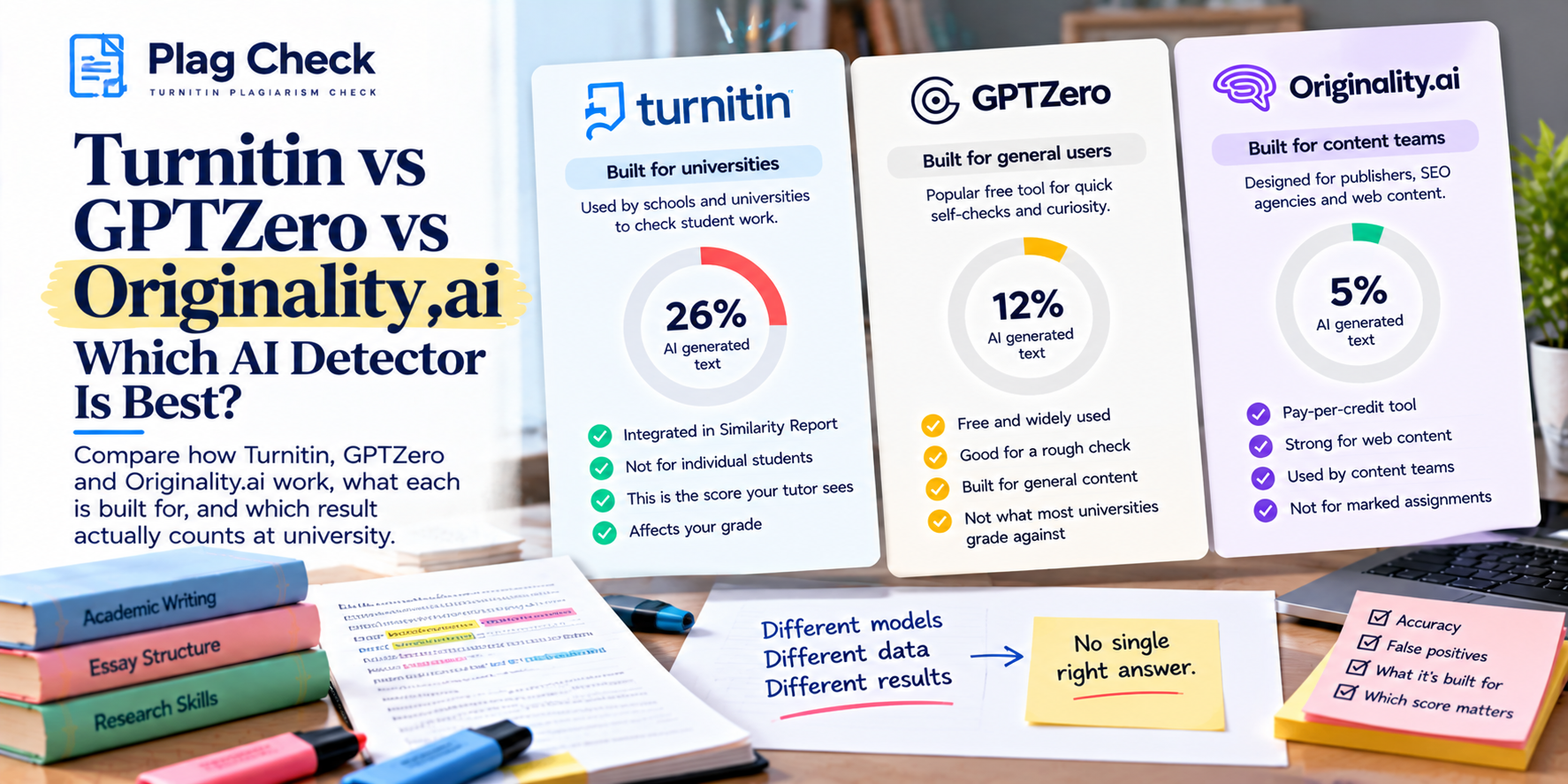
Turnitin has no separate detector for Gemini, Claude or DeepSeek, and it never names the tool you used. Its AI indicator scores how much of your text reads as machine-written, whatever model produced it. In practice it flags output from all three, though not every time, because the score is an estimate, not proof.
A year ago nearly every question we saw was about ChatGPT, and we answered it in detail in our guide on whether Turnitin can detect ChatGPT. Now students ask whether a different model is the safe one. Does Gemini get picked up? Is Claude cleaner? Will DeepSeek slip past because it is newer? Fair questions, and the short version is that the brand on the chatbot matters far less than people hope.
How does Turnitin’s AI detector actually work?
Turnitin’s AI indicator does not connect to any chatbot, read your browser history or watch what you typed. It only ever sees the finished document. As we explain in our full breakdown of how Turnitin AI detection works, it reads your prose and measures how predictable it is, sentence by sentence. In plain terms it asks one question of each sentence: given everything before it, is this the kind of wording a machine tends to produce, or the kind a person tends to produce?
Human writing is bumpier than most people realise. We vary our sentence length, we take odd turns, we repeat ourselves unevenly, and we drop in detail a model would not think to add. Large language models tend to write smoothly and evenly, because they are built to pick the most likely next word. That evenness is the signal Turnitin is tuned to notice.
Because the indicator works on that pattern and not on a hidden fingerprint from a particular app, it cannot say “this came from Gemini” or “this is Claude”. It has no way to know. It only outputs an overall percentage of the text it believes was AI-written, and it highlights the passages behind that figure. It also only scores what Turnitin calls qualifying text, meaning long-form prose. Bullet lists, tables, headings, very short answers, poetry and code are not reliably assessed, so the percentage may not describe your whole document.
Can Turnitin catch Gemini, Claude and DeepSeek?
In practice, yes, more often than not. Turnitin says its model is trained to recognise AI writing in general rather than one brand, and that it aims to keep false positives under 1% on documents scored above 20% AI. Output from Gemini, Claude and DeepSeek carries the same broad smoothness as any other large model, so it tends to land inside the range the indicator was built to catch. Here is the honest picture for each:
- Gemini: Google’s model writes in the same fluent, evenly structured way detectors are sensitive to, so unedited Gemini text is frequently flagged.
- Claude: Claude often writes in a more natural, varied style, which can make lightly used output harder to score, but substantial Claude-written passages still tend to show up.
- DeepSeek: being newer or less mainstream does not grant a free pass. The indicator looks at writing patterns, not a list of known tools, so DeepSeek output is treated the same as any other model’s.
None of that is a guarantee in either direction. Because the score is a probability, genuine AI text can occasionally slip through, and some entirely human text gets flagged. That is the nature of a statistical model, and it is exactly why a score is a reason to look closer, never a verdict on its own.
Does switching to a smarter model help?
The logic sounds reasonable: newer models write better, so they should read as more human. The flaw is that Turnitin keeps updating its own model too. It has retrained its detector more than once and added layers that look for text which has been deliberately disguised. So swapping chatbots is a race against a system that is also moving, and you would be betting your academic record on staying ahead of it.
There is a quieter problem too. Even when a model writes fluently, it writes generically. It leans on safe phrasing, balanced both-sides sentences and tidy conclusions. Markers notice that tone long before any software does, and a tutor who suspects AI can simply ask you to explain your own argument in a tutorial. No detector score helps you there.
What actually changes your AI score?
If you have used AI at all, three things change the result far more than which model you picked:
- How much you rewrote it. Genuinely rewriting ideas in your own words and structure lowers the AI signal. Changing a handful of words does not.
- Whether you ran it through a humaniser. Paraphrasers and so-called humaniser tools used to drop the score, which is why we cover Turnitin’s bypasser detection separately. Bypassed text is now counted inside the single AI percentage, so that route often makes things look worse, not better. The same applies to spinners like QuillBot, as we show in our guide on whether Turnitin can detect QuillBot and other paraphrasing tools.
- How much is AI at all? A few AI-assisted sentences in an otherwise human essay behave very differently from an essay that is mostly generated.
What do we see when students check drafts with us?
Running Turnitin reports for students all day gives you a clear pattern. The drafts that come back with a high AI figure are rarely the work of one specific chatbot. They are the ones written in that flat, evenly paced, slightly hollow style, whatever tool produced it. The drafts that come back clean are the ones with a real voice: uneven sentences, specific examples, the odd tangent, a point argued slightly awkwardly because a person was thinking it through. That is the single most reliable way to keep an AI score low, and it has nothing to do with the brand of model.
What is the honest bottom line?
Moving from ChatGPT to Gemini, Claude or DeepSeek does not make AI writing invisible to Turnitin. The detector scores patterns common to all of them, it will not name the tool, and disguising the text with a humaniser is the exact behaviour its newer checks target. If the work is yours and you used AI only for support, keep your drafts, notes and sources so you can show how you built the piece. And if you want to see roughly what Turnitin would make of your writing before a marker does, check a draft yourself first.
Frequently Ask Questions
Does Turnitin detect Gemini?
It can, and often does. Turnitin has no Gemini-specific detector, but its AI indicator flags the machine-writing patterns Gemini output tends to have. The result is a probability, not a certainty.
Is Claude or DeepSeek harder for Turnitin to catch than ChatGPT?
Not in any dependable way. All three share the smooth, even style detectors are tuned for. A newer or less common model is not a safe route, because Turnitin scores writing patterns, not known tools.
Will Turnitin tell my tutor which AI tool I used?
No. It only produces an overall AI percentage and highlights the passages behind it. It does not name a tool or confirm for certain that one was used.
Does paraphrasing AI text from these tools hide it?
Not reliably. Turnitin now detects AI text run through a paraphraser or humaniser and counts it inside the same AI score, so disguising it often backfires.
Can a human essay be wrongly flagged as Gemini or Claude?
Yes. False positives happen, more often with short, plain or repetitive writing, which is why a high score should start a review of the text, not an automatic accusation.