Turnitin AI detection is an AI writing indicator inside the Turnitin Similarity Report. It estimates what percentage of a document’s long-form prose was likely written, or rewritten, by an AI tool. Turnitin says it is tuned to keep false positives under 1% on documents above a 20% AI score, which means it misses some AI text on purpose.
If your university uses Turnitin, there is a good chance your next assignment will get two numbers: a similarity score and an AI writing score. Most students understand the first. Very few know how the second is produced, why it sometimes shows an asterisk instead of a number, or how much weight a tutor should give it.
This guide covers how the detector works, what it scans and ignores, how to read each type of score, what the accuracy evidence actually says, and what to do if your own work is flagged. If you want a quick yes or no on one tool, start with Can Turnitin detect ChatGPT?.
What is Turnitin AI detection?
It is a feature of the Turnitin Similarity Report, not a separate product. Turnitin’s AI writing FAQs state it is only available to institutions that license Turnitin Originality, or to iThenticate 2.0 customers who buy the AI add-on. Universities on other Turnitin packages, or that have switched it off, see no AI score.
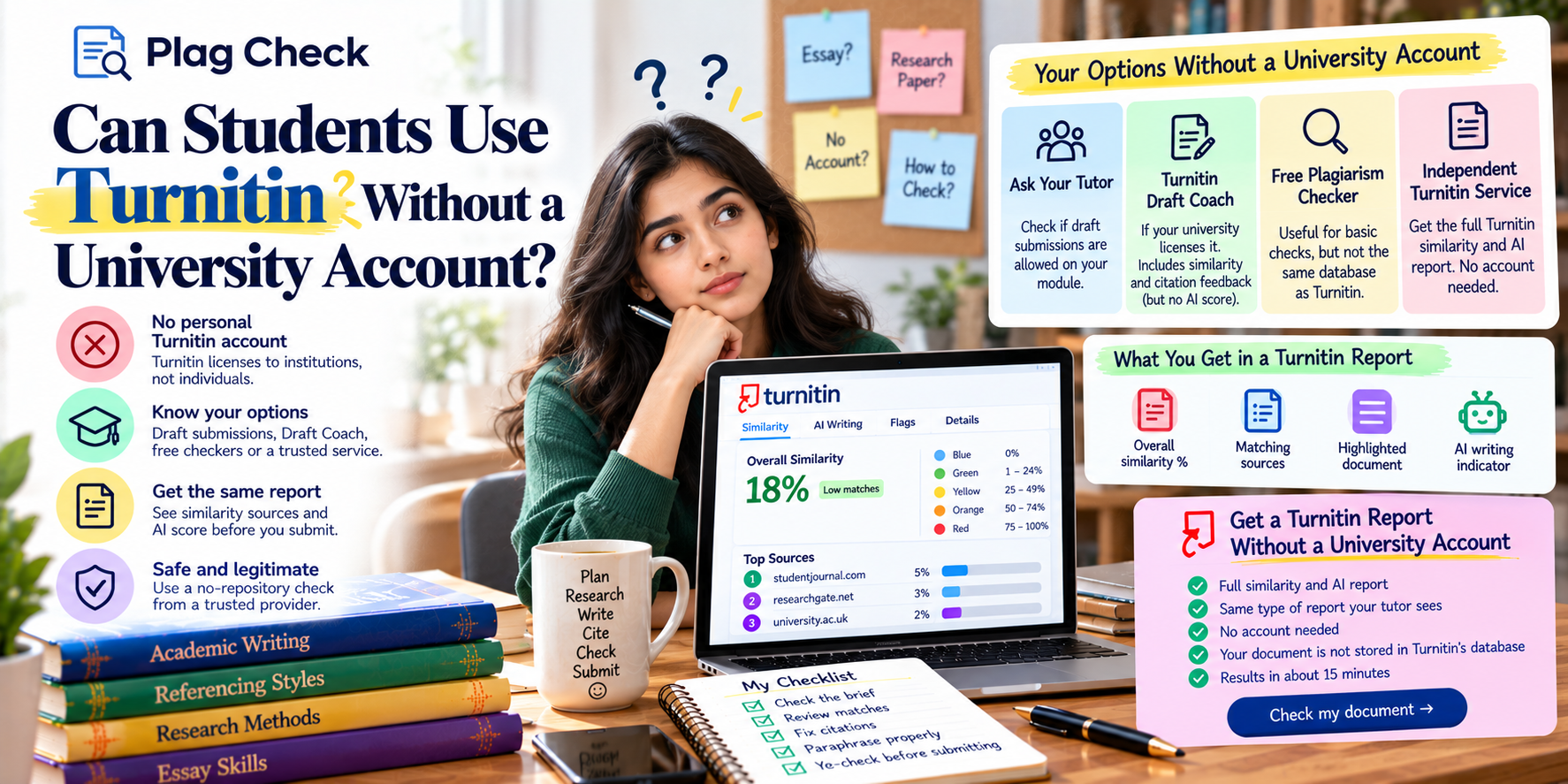
Three facts shape everything else about the feature. First, it is licensed per institution, so whether your work gets an AI score depends on your university’s contract and settings. Second, Turnitin states that the AI indicator and report are not visible to students in the standard submission flow; a tutor can download and share the report, but you will not see it yourself when you submit. Third, the AI writing percentage is completely separate from the similarity score. One does not raise or lower the other.
That second point is why pre-submission checks exist. If you want to see both numbers before your tutor does, read how to check your Turnitin score before submitting.
How does Turnitin’s AI writing indicator score a document?
Turnitin splits your text into overlapping segments, gives each segment a score between 0 and 1 for how likely it is to be AI-generated, combines those into sentence-level predictions and then calculates one percentage for the whole document. Only qualifying prose counts towards that percentage.
Because the segments overlap, most sentences are scored several times and the results are pooled. That makes long documents more stable. Turnitin’s own FAQs warn that a document of only a few hundred words gets a prediction that is close to ‘all or nothing’, so short submissions can swing sharply.
Turnitin describes its current system as a transformer-based deep learning model trained on academic writing. Many older explainers say Turnitin measures ‘perplexity’ and ‘burstiness’. Turnitin’s documentation says its model is not programmed to evaluate those two features directly, and that individual predictions may not be explainable feature by feature. In plain terms: you cannot reverse-engineer why one specific sentence was flagged.
What does Turnitin scan, and what does it ignore?
Turnitin only analyses long-form prose written in paragraphs. It needs at least 300 words of qualifying text and accepts up to 30,000 words in .docx, .pdf, .txt or .rtf format. Bullet points, lists, tables, code and bibliographies are excluded, which is why the AI percentage often does not match the amount of highlighted text.
| Requirement | Turnitin’s limit | If you miss it |
|---|---|---|
| Minimum length | 300 words of prose in paragraphs | No AI score; the indicator shows a dash |
| Maximum length | 30,000 words | Not processed for AI |
| File type | docx, pdf, txt or rtf | Not processed for AI |
| Language | English, Spanish, Japanese; Turnitin release notes add Modern Standard Arabic from August 2026 | No AI score for other languages |
| Text type | Prose sentences only | Lists, code and references are invisible to the score |
The language point matters if you write in more than one language. Turnitin’s AI paraphrasing and bypasser detection is English-only, according to its documentation, so the same feature does not behave identically across languages.
What do the different AI scores mean?
A blue percentage from 20% to 100% is a scored result. An asterisk means Turnitin detected some AI writing between 1% and 19% but deliberately withheld the number and highlights. A grey dash means the file was not processed, and an exclamation mark means a processing error. Only the blue percentage is a usable number.
| What you see | What it means | How much weight it carries |
|---|---|---|
| 0% | No AI writing detected in the qualifying prose | None |
| Asterisk (*%) | AI detected somewhere in the 1% to 19% range; number hidden | Low. Turnitin itself treats this range as unreliable |
| 20% to 100% (blue) | Estimated share of qualifying prose likely AI-generated or AI-modified | A starting point for a conversation, not proof |
| Grey dash | Not processed (length, format or language) | None |
| Exclamation mark | Processing error | Resubmit |
The asterisk is the most misunderstood part of the report. Turnitin’s release notes say that since July 2024 no score or highlights are given for results in the 1% to 19% range, to avoid false positives. An asterisk is Turnitin saying its own low-range output is too noisy to print. For what tutors typically accept, read what AI score is acceptable on Turnitin.
Turnitin also says the score is tuned to undercount. Its FAQs give the example that a document scored at 50% could contain as much as 65% AI writing. The trade-off is deliberate: fewer innocent students flagged, more AI text missed.
Which AI tools can Turnitin detect?
Turnitin’s FAQs list coverage for more than 30 named language models, including recent versions of GPT, Claude, Gemini, Llama, Mistral, DeepSeek and Grok. Turnitin also says it detects tools built on those models. This is a claim about training coverage, not a published detection rate for each model.
The list is long and updated often, so treat any ‘Turnitin cannot detect model X’ claim online with suspicion until you have checked Turnitin’s current FAQ page. Turnitin does not publish accuracy figures per model, so nobody outside Turnitin can say how well it catches one specific tool.
Paraphrasing and ‘humaniser’ tools are a separate question. Turnitin added AI paraphrasing detection in December 2023 and, according to its release notes, extended detection to AI bypasser tools on 27 August 2025. On 4 August 2026 it merged the separate purple ‘AI-paraphrased’ highlight into the main AI category, so a single percentage now covers AI text whether or not it was run through a paraphraser. Read more in can Turnitin detect QuillBot? and Turnitin bypasser detection.
How accurate is Turnitin AI detection?
Turnitin claims a false positive rate under 1% on documents where more than 20% of the text is flagged, tested against over 700,000 papers written before ChatGPT launched. Independent testing agrees false positives are now rare, but a June 2026 peer-reviewed study found Turnitin missed every fully AI-generated paper in its sample.
| Source | What was tested | Result for Turnitin |
|---|---|---|
| Turnitin’s own claim (AI writing FAQs) | Validation on 700,000+ pre-ChatGPT academic papers | Under 1% false positives above a 20% AI score |
| Walters, Open Information Science (2023) | 126 documents: ChatGPT-3.5, ChatGPT-4 and human essays | Classified all 126 correctly; one of two tools out of 16 to do so |
| Van Vlasselaer, Van Droogenbroeck and Spruyt, International Journal for Educational Integrity (June 2026) | 160 papers of 4,000+ words: human, fully AI, hybrid and humanised | No false positives on human papers; 0% scored on all fully AI papers; 60% accuracy on hybrid; 50% on humanised |
Two qualifications for the 2026 study. The AI papers were generated in May 2025, and Turnitin has updated its model several times since, without re-scoring old submissions. And the study used long papers, the format Turnitin should handle best.
One statistic you will see everywhere does not apply to Turnitin. The 2023 Stanford study by Liang and colleagues, which found a 61.3% average false positive rate on essays by non-native English writers, tested seven detectors. Turnitin was not one of them. The concern about second-language writers is still real; see Turnitin AI false positives for who is most at risk.
Have any universities switched Turnitin AI detection off?
Yes. Universities including Vanderbilt (August 2023), the University of Waterloo (September 2025), the University of Cape Town (October 2025) and Curtin University (1 January 2026) have disabled the AI writing feature. In each case they kept Turnitin’s normal similarity checking switched on.
Curtin’s student notice is typical: the AI writing detection feature was disabled across all campuses from 1 January 2026, while the regular text-matching checks stayed active. Other institutions, such as the University of Queensland, made the AI indicator unavailable while keeping the similarity report.
So the first question when you see an AI score in a report is not ‘how high is it?’ but ‘does my university use it, and how?’ Check your module handbook or academic integrity policy. Many now state that an AI detector result alone is not enough evidence of misconduct.
Is Turnitin’s AI score the same as its similarity score?
No. The similarity score compares your text with Turnitin’s database of web pages, publications and past student papers. The AI score predicts whether a language model wrote your prose and uses no database at all. Turnitin states the two are completely independent, so a document can score high on one and zero on the other.
Mixing these up causes a lot of panic. A 25% similarity score usually means unquoted or poorly paraphrased source material. A 25% AI score means Turnitin’s model thinks a quarter of the qualifying prose looks machine-written. They need different fixes. For the similarity side, start with Turnitin similarity report explained.
See both scores before your tutor does Get your Turnitin similarity report and AI writing report as PDFs in about 15 minutes. No account needed. Check my document | In the US? Use our US checker
What should you do if your work is flagged?
Stay calm and gather evidence of how you wrote the work: version history, drafts, notes, outlines and timestamps. Ask for the exact score and whether it was above 20%. Check your university’s policy on AI detector evidence. Turnitin itself says the AI percentage should not be the sole basis for action.
- Ask for the report. You are entitled to know the exact percentage and which passages were highlighted.
- Collect process evidence. Google Docs or Word version history is the strongest proof you wrote something over time. Running your essay through a different AI detector is weak evidence by comparison.
- Check the policy. Most universities now say detector output alone cannot prove misconduct.
- Explain relevant context in writing. If English is not your first language, or you have a learning difference that affects your writing style, say so early.
- If you used AI where allowed, show it. Keep prompts and drafts and disclose the tool as your module requires.
Turnitin’s own guidance for instructors frames a high AI score as ‘a good starting point for discussing’ the work with the student, not a verdict. For a full walkthrough of appeals and evidence, read why human writing gets flagged as AI. If you want to know your AI score before you submit, here is how to check your Turnitin score before submitting.
Check your AI score before you submit Upload once, get your similarity and AI reports by email. Upload your document
Frequently asked questions
Can Turnitin detect ChatGPT?
Turnitin lists recent GPT models among those its AI detector is trained to recognise, and it often flags unedited ChatGPT text. It is not certain, and peer-reviewed testing in 2026 showed it can miss long AI-generated papers. See can Turnitin detect ChatGPT? for the full answer.
What does an asterisk mean on a Turnitin AI score?
An asterisk means Turnitin found AI writing somewhere between 1% and 19% of the qualifying text but withheld the number and highlights because it considers that range unreliable. Turnitin introduced this in July 2024 to reduce false positives.
Can students see their Turnitin AI score?
Not in the standard submission flow. Turnitin states the AI writing indicator and report are not visible to students, though a tutor can share a PDF. Independent pre-submission services can send you a report before you submit.
How many words does Turnitin need for an AI score?
At least 300 words of prose in paragraphs, up to a maximum of 30,000 words, in a .docx, .pdf, .txt or .rtf file. Lists, tables, code and reference lists do not count towards the score.
Does Grammarly trigger Turnitin AI detection?
Turnitin says its detector is not tuned to flag ordinary spelling, grammar and punctuation corrections. Grammarly’s generative features, such as drafting, paraphrasing and summarising, are likely to be flagged as AI writing.
Is Turnitin AI detection accurate?
Turnitin claims under 1% false positives on documents above a 20% AI score. Independent studies agree false positives are now rare, but a June 2026 study in the International Journal for Educational Integrity found Turnitin scored 0% on every fully AI-generated paper it tested.